Through His Lens
Gainesville native Corey Williams is a fixture on youth football sidelines. His camera -- and his passion -- have brought eyes and offers to numerous athletes.
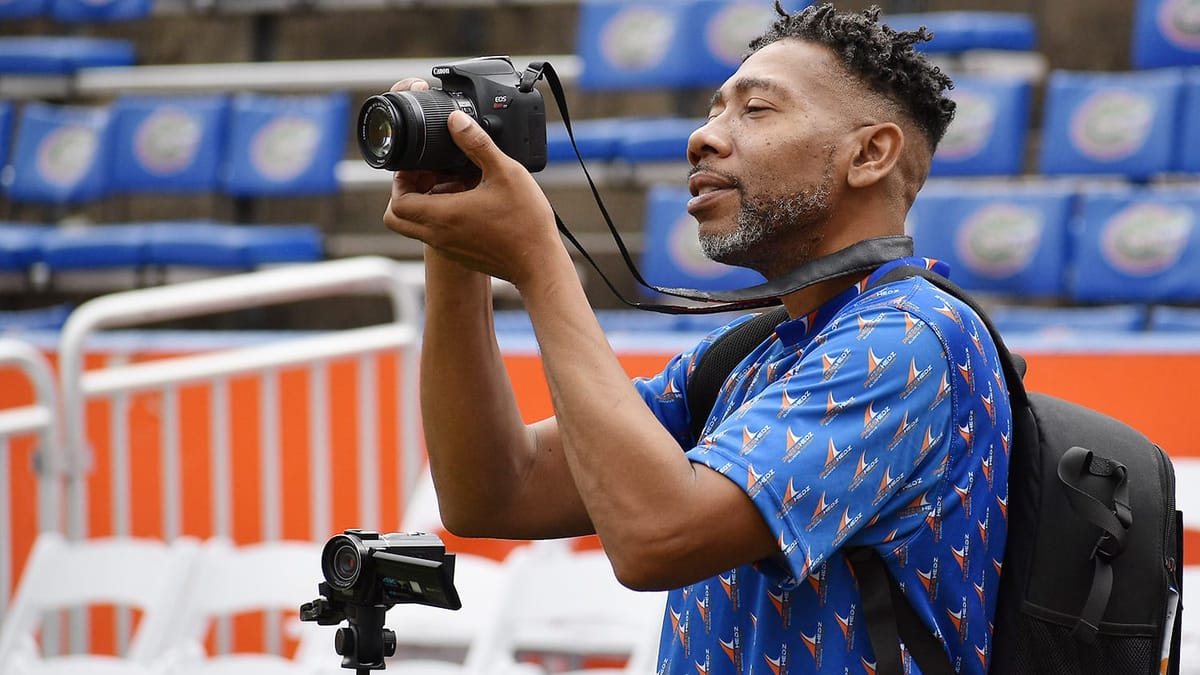
Vernell Brown III broke to his right, cut and exploded down the sideline. There was nothing but green grass ahead and six points waiting in the end zone. He made the sprint look effortless.
And he was just 8 years old.
On the near sideline, Corey Williams knelt in the fresh-cut grass of Gainesville’s Citizens Field, tracking the play through his camera lens. As soon as Brown crossed the goal line, Williams knew the dominant run would be perfect to add to his catalog of film, especially in a youth football world where highlights have become currency and Brown’s speed and agility turn heads. Within days, the clip would be edited into a highlight reel, stitched together with music frequently picked by the players themselves and then shared across social media.
Williams, a 49-year-old Gainesville, Florida native, has filmed youth football games for more than two decades, capturing many moments like Brown’s in 2015. But it's not just the future UF legacy receiver that he captured. Williams has recorded a slew of successful athletes, and his videos opened the door for athletes to be seen, developing their skills and personal brands. One of his first viral highlights garnered more than 70,000 views in its first week on Facebook in 2015, when he filmed a defensive player helping up a quarterback after a monster hit.
The core objective of his work is simple. Williams hopes to preserve memories and give young players a chance to be seen and discovered in a sport that increasingly demands visibility long before high school. Little did he know, he would end up filming notable athletes such as Quan Lee, Stanley Cooks and future Gators players Anthony Richardson, CJ Ingram, Justin Williams and Brown III early in their youth playing careers, giving him a firsthand view of how early exposure could shape a player’s development.

Mere decades ago, kids laced up their cleats for Pop Warner games, looking for fun after school or hoping to get fit. Now, the landscape of youth football has morphed into an unrecognizable world of scouting, recruiting and competitive play, amped by offseason 7-on-7 touch football programs and private training. Recreational football has become obsessed with statistics and highlight tapes, all in the hope of getting ahead in the recruiting process.
“You had to have a highlight tape for people to see your work,” Williams said. “That’s why I created those highlight tapes. … That’s what led them getting the invitations from 7 on 7; that’s what led to the national recognition.”
Shaped by the ripple downstream effects of name, image and likeness (NIL) opportunities, recruiting begins earlier than ever in the present landscape of youth football. Athletes who share film and create brands can separate themselves from the rest.
“At a 7-on-7 tournament, man, you can have a top receiver from Florida going against a top DB in California, so you get an opportunity to see the best of the best with the way 7-on-7 is set up,” said Vernell Brown Jr, VBIII's father and a former Florida cornerback himself. “That’s what’s driven it to become such a force in recruiting now.
"It’s a hotbed and an opportunity for you to see all the top players at the skilled positions play and compete against each other.”

For Williams, helping others find paths to success has kept him grounded through tragedy.
A three-year letterman at Gainesville High School, Williams played football and basketball throughout his high school years and subsequently became a Marine. While stationed in Quantico, Virginia, as a Marine, he won a football championship in 1995 as a running back and another in basketball in 1996 before returning to his hometown.

Williams returned to Gainesville in October 2001 to take care of his mother, who had cancer. He picked up filming after about a year as a side gig, helping young players promote their playing careers using tools he never had at their age. He also wrote poetry and made music under the pseudonym “Coochie Bird Jr.”
Williams met his fiancée, Iya Burkett, in 2009. The pair had their first child in March 2011, but their son died just three hours after birth. In 2012, the pair had their daughter, Cyniah, and their son, Cameron, was born three years later.
Then, in 2025, Burkett passed away to stage 4 liver cancer, leaving him to raise his kids alone. He was forced to put his home up for sale, but he continued his passion: providing resources for the youth, whether in or outside football.
Despite his life’s hardships, Williams credits being a father and the support from the community for keeping his head up. Filming the Alachua Raiders’ most recent season was therapeutic for both him and his family.
“I’m a Marine, I was born in the ‘90s — like it’s harder to find somebody harder than me,” Williams said. “But I know that I need support. I need somebody saying, ‘Hey, you can do it. Good job.’”
For Williams, that support is something he’s tried to pass on both through his work and to his children.
Years of lessons learned behind the camera have guided his approach to fatherhood and shaped the perspective he hopes to share with his kids. A little more than a year after his fiancée passed, Williams stood on the field at Ben Hill Griffin Stadium with Cameron. Much of the work Williams does is behind the scenes: early mornings and late nights, editing footage his kids rarely see. He brought his son out to the field to give Cameron a look at what gives Gainesville such a deeply rooted culture in football and a glimpse into the world his father has spent decades capturing from the sidelines.

The retired Marine views life and youth football through the same lens: Everyone is just as valuable to the central mission.
Topics like music, graphic design, sports media and entrepreneurship helped Williams connect with kids and open their eyes to opportunities outside sports.
“I try to teach the kids, be an example, because growing up here, my examples were selling drugs, not doing the right thing,” Williams said. “I can motivate the youth by recording their games, giving them highlights, letting them have TikToks and putting the music that they like together.”

Brown Jr.’s parents ran Gainesville Pop Warner when he was young, and once he and his brother, Vincent, had children of their own, they got involved in the Gainesville youth football scene again.
Between his stint as a Gators player (2001-05) and time as an employee of the University of Florida – where he served as director of student-athlete development in 2018, and was promoted to senior director of player development and alumni relations in 2022 – Brown Jr. founded the Gainesville Panthers in 2011 to provide kids with a fun environment to learn football. He quickly established “Age5toCollege” as a foundational slogan, and the Panthers taught boys essential life skills. They also explained the pathways to high school and college football to athlete’s families.
“We wanted to make sure we gave back to the community to give the kids that was coming behind us the best foundation,” Brown Jr. said.
After a couple of seasons running the program, Brown Jr. began to see film as an asset to the Panthers’ mission, giving young athletes a tangible way to track improvement, gain recognition and even prepare for opportunities beyond Gainesville. So he reconnected with Williams.
The two first met when Williams was in high school, where Vernell Brown Sr. coached and Brown Jr. spent time with the team.

In 2015, Williams approached Brown Jr. to film the Panthers and upload game clips and highlights across his social media pages to gain the organization’s players more recognition.
“He knew what I could do, and he knew what my mission was,” Williams said. “Help these kids go to college, get film and get better by looking at themselves playing over and over.”
Brown Jr. quickly noticed that after the program began to post game highlights, the community became more intrigued. Parents started looking for organizations that offer content teams in order to ensure their children get film they could show to recruiters and post online.
The Panthers were discontinued in 2016 when Brown Jr. took a position as director of operations with The Villages Youth Sports Club, but that didn’t stop Williams from editing and posting film of Brown Jr.’s sons, Corey and Vernell, when they followed and played with the Buffalo Stampeders.
Brown Jr. will still tell you that film doesn’t bring success on its own. It’s simply a catalyst used to jumpstart young players’ dreams of being recognized and advancing to the next level.
“When I see the results of VBII, Anthony Richardson, Justin Williams, it’s because they bought the DVDs, they watched the tape over and over, they went through it with their parents, they put in the work,” Williams said. “When you see yourself play, you see what you can do better.”

Not everyone believes film at a young age is as critical as it’s often made out to be.
Eric Williams, a friend of Corey and the father of University of Florida incoming freshman receiver Justin Williams, said Justin’s recruiting process looked different.
The Top 200 recruit committed to Florida last June, but it wasn’t always a straight shot. He was filmed by Corey Williams (no relation) at 8, when he played with the Panthers organization. But he only began turning heads around his sophomore year of high school when he started going to team camps and posting impressive 40-yard dash times.

Eric Williams believes that while film can be useful, true recruiting traction doesn’t begin until players reach high school. In his eyes, physical development, production and in-person evaluation start to matter more.
“Stats are one thing, and highlights are a lot,” Eric Williams said. “But your makeup, as far as your genetics, that’s important. And a 40-time is important, especially if you’re playing a skill position.”
Players need connections to be noticed in a landscape full of athletes vying for a spot at the next level. When people hear about 13-year-olds earning scholarships, someone typically knows somebody who can open doors for these young athletes, Williams said. Though film isn’t some magic mechanism able to materialize scholarships, social media allows young athletes to gain recognition much earlier. That attention brings those connections.
“Sometimes [as] a parent, you have to be honest with yourself,” Eric Williams said. “If you think your kid is something, or somebody else will think your kid is something, they’ll take him around. And then if he shows up, the rest will take care of itself.”
Corey Williams’ filming of Justin from a young age led to increased visibility in a crowded recruiting pool, even if his development came later on. He played alongside future UF teammate Brown III with the Panthers. In 2015, the pair capped a 16-0 season with a UYFL National Championship win.
“It means a lot that you’re just on the team regardless,” Eric Williams said. “People respect your organization, and they’re going to go to them and say, ‘Whatchu got? Who’s next?’”

From hopeful Gainesville natives to high-profile athletes, the journeys of Richardson, Justin Williams and Brown III mirror the vision Corey Williams has tried to document for years: film opens the door for opportunity, and football can serve as a vehicle for something much bigger.
For players like Brown, their talent, notably, was evident long before the cameras first followed, but the film and game-highlights were what brought the evidence to light.
More than a decade has passed since a young VBIII took the youth football by storm, and with the help of Williams' camera, he's now a college football star. Everyone recognizes him under the lights of Ben Hill Griffin Stadium.
Unnoticed? That's Williams. And on this November day, as he brings his son, Cameron, onto the field Brown darts around on Saturdays, it's for the better. No distractions. No worries. Just his camera, his son and his purpose.
He shows the lens and the controls to his 10-year-old – one not too dissimilar from another from, say, a decade ago. Then, in demonstration, he slips into the same moment he's lived so many times before. Williams is always there, intently watching from the sideline in hopes of benefiting Gainesville’s next generation.
He sits, camera raised, capturing yet another electric sprint to the goal line.
