The Great Equalizer
Above the Mason-Dixon Line, golf always has been a seasonal sport. Not anymore. Technology has leveled the field -- and now northern schools and golfers are no longer at a major competitive disadvantage.
The drive from Niskayuna to Canton takes four hours through the snow, mostly on single-lane New York highways. The Adirondacks can become lonely territory. God forbid a man’s mind wanders.
“Did I tell you about the bears?” Jimmy King asks, a Cage The Elephant song blasting from the college senior's speakers last winter, forcing him to repeat himself. “I feel like I see them pretty often out here. I’ve gotten so damn close to hitting them with my car before.”
The follow-up question, then, is simple: Should you, Mr. King, be on your phone while driv...
“They’re why I can’t golf.”
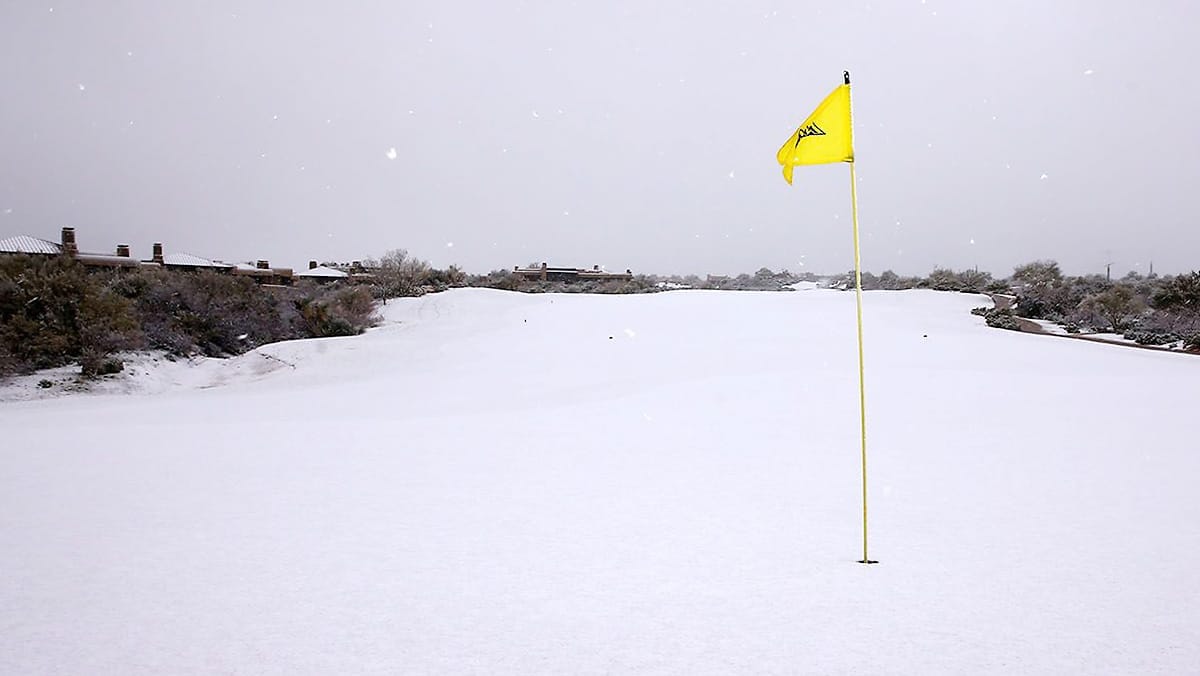
St. Lawrence University, the Division III school at which King is a player on its men's golf team, is roughly 10 miles from the Canadian border, just beyond the sprawling lakes of northern New York. The college, subsequently, is layered in snow from November to March. Yet, on the off-shot there’s no precipitation, the Saints’ men’s golf team can face another challenge.
Bears wander the Oliver D. Appleton Golf Course occasionally throughout the year. It’s realistically possible that St. Lawrence County, the most northern in New York, is home to a bruin per every 25 residents, according to recent censuses.
If it's not always 70 degrees and sunny, you’re already at a disadvantage in golf when competing with schools like the University of Florida, which can play 24/7, 365. Any additional outside variables sustain or spoil collegiate teams on the fringe. This Liberty League school, which has never won its conference championship — and, thus, hasn’t made the NCAA tournament — is no exception.
“We were slipping,” St. Lawrence head golf coach Dave Clausen says. “The weather, outside circumstances, everything feels stacked against playing golf in this type of location."
So?
“We [started] hitting the ball into a wall.”


Just along the hairy fringes of the sports ecosphere, golf meshes daily life with athleticism. You can play, the sport tells generations of aspiring golfers. Businesses conduct client meetings on the course, grandparents bring their physical therapy to the fairway and finance students practically grow Martha’s Vineyard polos upon graduation. Weekend hackers are everywhere because golf, like no other sport, is a way of life.
Within its campaign to be the common man’s practice, though, lies an obvious flaw. You can’t play if you don’t reside in the right location.
But that’s not necessarily the case any more. In this parallel world, you no longer need a course to practice because of cutting-edge technology, which has prodigiously improved golf simulators and stat-trackers in recent years. At least that’s what St. Lawrence — and many others — wants you to think.
The premise is simple. Teams and players in places where the weather doesn’t permit year-round play or the financials don’t align with frequent rounds have another route into the sport, training primarily in a virtual capacity. Northern college teams, St. Lawrence included, benefit the most amid an unraveling string of training and recruiting gains. It's easier for snowed-in schools to practice. Possibly of even greater effect, it's easier for younger players to get in the game.
“I track literally everything you can think of with that thing,” said Blake Phillips, a rising amateur golfer from Australia, who was advanced at such a young age, he bypassed collegiate play to turn pro. Like so many others, he doesn’t have the benefit of playing outside every day. Instead, he turned to simulators years ago and has seen how they’ve improved in just the last half-decade. “It’ll measure club velocity, angle, club path. I get to see the ball’s projected path and distance like on a real course. The thing measures my spin rate, God knows how.
“Golf technology has never been more advanced.”
When you used to watch the morning weather forecast, your meteorologist’s educated projection came about similarly to the analytics of Phillips’ most recent sliced shot. Top companies like Trackman and FlightScope use Doppler radars to quantify the ball’s and club’s movements.
The systems — coupled with cameras, in some instances — measure each object’s motion after a user hits a ball. Those are the initial stats they provide, like launch angle and club velocity. Computers within simulators and on-course boxes then provide even further projection analytics about each specific swing’s performance, like Phillips’ spin rate.
The most advanced options feature virtual reality, which has been proven to work. Testing showed a significant positive relationship between golf performance under real and virtual circumstances, according to a study performed by a group of sports science and psychology professors from the United Kingdom’s Universities of Exeter and Leeds. Their conclusion: golf putting simulators were generally representative of the real game, as expert golfers remained stronger than novices and users felt immersed. Participants who performed better in the real-world putting task also tended to perform better in the VR putting task.
For those like St. Lawrence, who can’t play for significant portions of the year, swinging into a computer has become the next best thing, especially with how the sport’s technology has improved.
The Saints have only been doing this for a limited time, though, so tangible results aren’t definitive quite yet. That hasn’t discouraged their efforts, but those on the frontier, like Phillips, already know what they can unlock when they devote themselves to this tech revolution.

At the Porter Cup, wealth floats through the air even more than the Niagara Falls mist just a few miles south. Teenage players travel from around the world, $1,000 clubs and $300 golf ball sets in tow. When the day’s play is over, parents dole out extra cash for “Maid of the Mist” boat dousings under northern New York’s finest attraction west of the Hudson River. Earlier, when rounds are still ongoing, players sit at linen-clothed patio tables, chatter percolating about who the next Tiger — yes, that Tiger played here when it only required a $100 registration fee — is in this year’s field.
“This is one the most attractive amateur events in the country,” tournament chair Marty Shimmel says. “We have a history. You come here to be the best and to play the best.”
The Niagara Falls Country Club tournament, a staple of the U.S. amateur circuit, has long been a leaping off point for the best. Yet what unites the frames of past players that hang on the club’s walls — featuring Phil Mickelson, Brooks Koepka and Dustin Johnson, among others — was their resources. Whether they grew up in warmth or had the money to find it, they’d play outside through the spring until the mid-summer tournament.
The most recent picture that hung after this July, though, tells a different story.
Back home in Sydney, the ball whips from Phillips’ TaylorMade into a wall. A tablet lights up behind his head, followed by a mumbled curse and another swing. He’s staring down an AI-infused, simulator-generated version of similar design to Niagara’s 18th hole — the one he won the Porter Cup on a couple of weeks earlier. Amid a rapid ascension through the World Amateur Golf Rankings this season, Niagara was just another blip on the map. Though he definitely is already having an effect.
When the shaggy-haired Australian wandered down the 18th hole earlier in July — this time, in real life — he was an exception. His bag was years old. His clubs weren’t worth your college tuition. “You can break ‘em. I’ll find a tree branch somewhere,” Phillips said. Yet he was about to win one of the United States’ longest-standing amateur golf championships. Why: “I know this type of course like I’ve played it 100 times. Because I have.”
As crazy as it sounds, tournament organizers believe this year’s competition was stronger than many of its predecessors. Younger players are more developed than in the past.
“We’ve never seen golf technology at a better place,” says Marty Shimmel, who’s been involved in Niagara’s operation for over two decades. “It feels like each year our field is more advanced than the last. Amateur golf is rapidly improving.
“Which means college golf is, too.”

The pendulum of dominance in collegiate golf has swung lightly — though not entirely — toward the little (cold) guy.
“We’ve seen significantly more northern teams compete as of late,” says Florida men’s golf coach J.C. Deacon. The school has won five national championships — four since 1970 is tied for the third-most in the country — with the most recent coming in 2023. “Technology is evening things … allowing teams that don’t have our weather to keep improving in a way they never could before.”

Illinois, which consistently championed golf AI and simulator usage before most other schools, has remained a staple of the NCAA Men's Golf Championship for the past decade. In 2024, the Illini were joined by Ohio State, another simulator-happy program, in the final tournament, marking the first time since 2011 that two schools north of the Mason-Dixon Line made the NCAA Men's Championship final in the same year. It’s worth noting, the last northern school to win the Division I men's title was Minnesota in 2002 … the year after Florida won its fourth title. The only other northern schools to win a men's title in the past 75 years were Ohio State (1979) and Purdue (1961).
Consider lower collegiate tournaments, then, an incubator for this theory. In 2024, Colorado Christian won the Division II men's national championship, while three of the previous six Division III champions were from Ohio, Illinois or Pennsylvania.
St. Lawrence, rightfully, feels like it's primed to break through.
“We’re getting closer,” King says confidently. “It’s hard playing golf in the north, but with the resources we have now, I feel like it’s getting more even.
“I really think we’ll be able to compete with anybody.”
After finishing his drive to Canton — it was five hours … because a different driver hit a bear, blocking the highway — King weaves toward St. Lawrence University’s Golf Training Center. Upon entry, what used to be a poorly turf-carpeted putting green has been replaced with a FlightScope simulator, which players like King take turns utilizing from 6 a.m. to midnight each day, desperately grasping at every opportunity to stay active.

St. Lawrence and many other smaller northern schools (the university has an enrollment of 2,175) operate a schedule that isn’t conducive to developing rhythm. Its season starts in the fall, enters a four-month snow coma, and resumes for its final three competitions in the span of three April weeks, including its conference championship.
“We play because we love golf, but we want to make the NCAA tournament,” senior Ben Scholes says. “If we win the Liberty League, we go. And if we go, our program survives.”
But postseason aspirations can be pretentious when competing with the Florida’s of the world to land top talent. Even as training options improve, recruiting is still skewed when talent is condensed to a few specific states.

The International Junior Masters, a prestigious high-school-age tournament 20 minutes down the road from the Porter Cup has churned out a number of future collegiate and professional players in recent years, including former UF golfer Ryan Hart. Its winners are among the best in the nation, and some participants travel from across the world, with 14 countries represented in the 2025 tournament.
On this June night, however, a 14-year-old toppled nearly all of them.
East Aurora Country Club had only four witnesses on its campus at 9 p.m. as the final duel of the quarterfinals finished, Francisco Cupp besting Mexico’s Luis Eboli. His win, though, could be heard throughout the college recruiting world.
“I’ve been playing for as long as I can remember,” Cupp says through a braces-laden smile, standing a confident 5-foot-3. During the day, a group of older players asked if he’d called out of his fifth-grade class to attend, not that any of it bothers him.
“Because I’m in New York, I started using tech early, too," Cupp says. "That training is the reason we’re here and the reason I’m beating a lot of these guys.”
Cupp is also on the frontier, to be clear. His father, Josh, was a collegiate golf coach at American University and Skidmore College, who’s now a club pro in eastern New York. Seeking competitive advantages — especially while golfing in the snow-covered slopes of Saratoga Springs — was a career-sustaining choice. So Cupp reaped the benefits of forward-thinking before most, but there will be more TikTok-emoting teenagers in competitive events soon.
In the past, becoming competitive at golf at a young age has been challenging. Across the U.S., there’s a lack of youth opportunities within the sport, no matter your finances. Most players start in middle school or high school, at the earliest. The lucky — PGA and LPGA Tour players — frequently are on a course earlier than most, whether it be because a family member plays or their parents have an obsession over Tiger.
But simulators now ease the climb into the sport.

“Training is really night and day from where it was a decade ago,” says Jeff Kamien, director of the IJM. “Kids, especially, are getting to train in a way we haven’t seen before.”
While costly in its own right, playing in a simulator at a local shop is similar to paying for a round on a course. Parents don’t need to overly invest in hours-long attention-testing lessons for their child, which few can afford in the first place.
Youth interest in golf, especially its technology-infused product, comes from what they’re watching.
Four hours south of Gainesville, Palm Beach State College hosted the inaugural season of the TMRW Golf League (TGL) in January 2025. It features Woods, Rory McIlroy, UF alum Billy Horschel and many other PGA members competing in a combined version of regular and simulator golf, where they play out short-game situations, but every drive is shot into a screen. It’s fast, the perfect attraction for kids.
“It's not traditional golf, yes. But it is golf. And that's the main thing,” Woods said, with McIlroy echoing the sentiment: “I see this as being complementary to everything else that is going on in the world of golf.”


The field, nevertheless, will never be entirely even.
Near the top of the list of disadvantages northern schools continue to face is, unexpectedly, that southern teams get to practice in the rain. You can count on The Swamp having a couple of soggy days throughout the winter and early spring. With the NCAA Championship in Carlsbad, California, UF’s atmosphere proves beneficial. Come late May, SoCal is overcast only about 15% of the time, according to the National Weather Service. Across the six-day event, odds are in favor of teams having to play through at least one muck, which schools that practice entirely inside never become accustomed to.
“There are certain things that when you come outside and start hitting balls outside, you’re just not going to be able to quite simulate it indoors,” UF golfer Jack Turner says, before adding another argument against places like St. Lawrence’s intensive indoor training schedule. “I kind of equate it to basketball. … If you scrimmage for two hours every single day, you’re just going to get so burnt out.”
Saints golfers agreed, citing overwork issues throughout their months inside. Simulators haven’t reached exact replication of the outdoor game. Thus, players feel like they need to push harder indoors to make up for lost ground.
Those with the resources of UF have struck the perfect combination, utilizing Trackman trackers on the outdoor course. Turner can measure every movement of his ball and club while getting the real experience of what spring play will bring.
“There are always going to be differences between the simulator and the real thing,” Clausen begrudgingly groans after some prying. “You prepare for everything you can, and while we are so much further along than we’ve ever been before, you still have to play the hand you’re dealt.”
And bears weren’t mentioned when Clausen accepted St. Lawrence’s position. But what was — the weather — is slowly becoming less of a factor.
“I hate to say this,” Clausen coughs out. “I love these robots.”
